 HopBase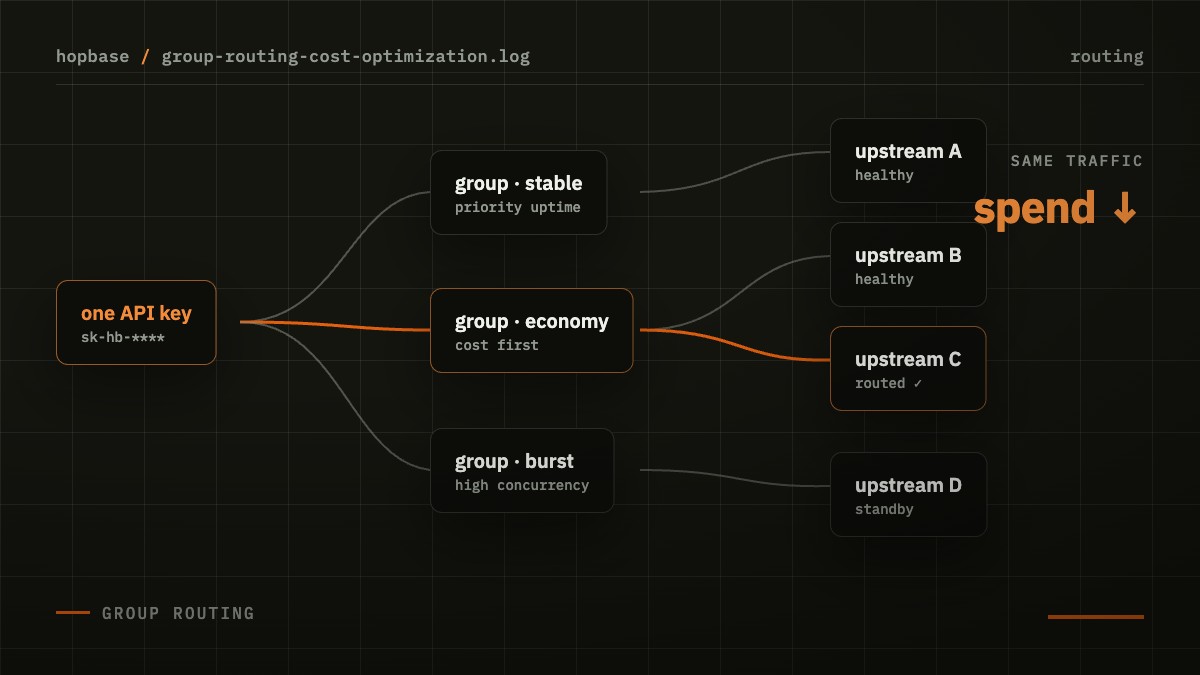
When optimizing LLM API costs, most people's first instinct is "pick a cheaper model." But in the real bills we see, the bigger savings usually come from "same model, different routing path." This article explains how group routing works and how to dial in a cost-saving setup that fits your usage pattern.
What Are Groups?
A gateway organizes upstream resources into groups by "service quality × price." The same model costs differently depending on which group's key you use:
| Group | Positioning | Best for |
|---|---|---|
| Stable | Multi-source redundancy, automatic failover, standard multiplier | Production integrations, daily development workhorse |
| Fast | First-token latency priority, slightly higher multiplier | Latency-sensitive interactive sessions |
| Economy | Lowest multiplier, may queue at peak | Batch jobs, offline processing, testing |
A key is bound to one group. Switching groups doesn't require code changes — just swap which key you use or reassign the key in the console.
Automatic Failover Means What?
Behind the Stable group are multiple upstream channels. If one gets throttled or unstable, the gateway switches automatically at request level — your caller only sees "that one was a bit slower," not a 5xx error. You don't have to write retry logic, circuit breakers, or multi-vendor adapters yourself — that's the whole point of a gateway.
Setup Recommendations for Three Profiles
- Solo developer: One key on Stable for coding; a second key on Economy for test runs and batch scripts. Two keys, separate billing views, crystal-clear cost breakdown.
- Small team: Distribute keys by role (frontend, CI, production). Production uses Stable, CI uses Economy. CI pulls full caching discounts — often your bill rounds down to negligible.
- Content / data bulk processing: Route everything through Economy, schedule batch runs in off-peak hours. Any time-sensitive final validation goes to Stable.
Order of Cost Optimization
First, capture cache discounts (prompt rewrite, zero cost). Second, pick the right group (architecture decision, configure once). Third, consider model changes (quality tradeoff, move carefully). Follow that order and most bills drop noticeably without sacrificing quality — your usage page never lies.