 HopBase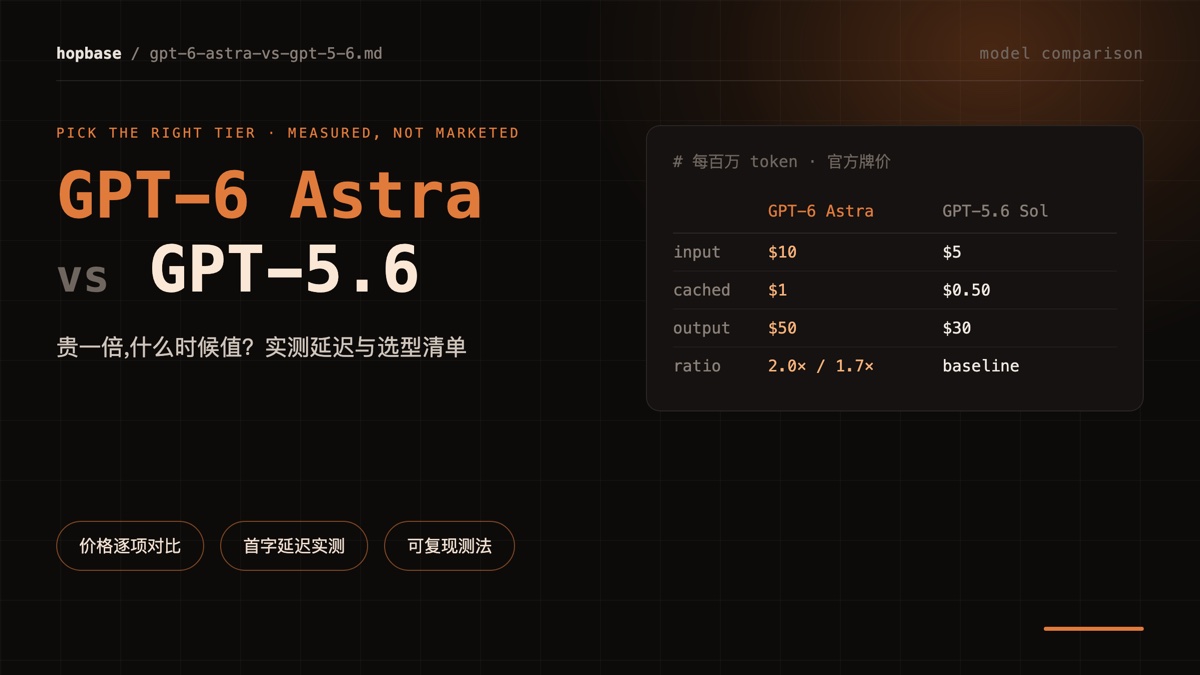
The short answer: GPT-6 Astra costs 2.00x GPT-5.6 Sol on input and about 1.67x on output — $10 / $1 / $50 versus $5 / $0.50 / $30 per million tokens. But in our own measurements on the production path on 2026-09-05, streaming first-token latency for both lands in the same range, with GPT-6 Astra's twelve samples falling between 1.5 and 3.6 seconds. So the decision should not turn on which version number is higher. It should turn on the cost of a single failed task. Work that has to be right the first time — long-running agents, cross-file refactors, multi-step reasoning and planning — earns back the price gap the moment it saves one round of rework. Work where a retry is cheap — high-frequency short answers, classification, extraction, bulk rewriting — is still better served by the 5.6 tier. Below: the line-by-line prices, per-call cost math for two real workloads, a reproducible latency test you can run yourself, and a three-step checklist.
Prices, line by line
| Per 1M tokens | GPT-6 Astra | GPT-5.6 Sol | Ratio |
|---|---|---|---|
| Input | $10 | $5 | 2.00× |
| Cached input | $1 | $0.50 | 2.00× |
| Output | $50 | $30 | 1.67× |
Both are served at OpenAI list price, and the ratio between the two tiers is constant. That means "how much more expensive" does not depend on how you use it — only on your input/output mix. The more output-heavy your workload, the closer the blended ratio gets to 1.67x; the more input-heavy, the closer to 2.00x. Full pricing is on the pricing page.
What one call actually costs
Ratios are hard to reason about, so here are two real workloads.
Workload A: one-shot long document (20K input tokens, 2K output tokens, no cache)
- GPT-5.6 Sol: 20000 × $5/1M + 2000 × $30/1M = $0.160
- GPT-6 Astra: 20000 × $10/1M + 2000 × $50/1M = $0.300
- Difference: $0.14 per call, about 1.88×
Workload B: agent loop (same 20K input, but 80% hits prompt cache, 2K output)
- GPT-5.6 Sol: 4000 × $5/1M + 16000 × $0.5/1M + 2000 × $30/1M = $0.088
- GPT-6 Astra: 4000 × $10/1M + 16000 × $1/1M + 2000 × $50/1M = $0.156
- Difference: $0.068 per call, about 1.77×
Caching cuts the absolute gap by more than half. That is why a high-frequency agent workload should get its cache hit rate up before anyone argues about switching models. How to do that: the prompt cache cost guide.
Latency: how we measured it, and how to reproduce it
First, a trap worth naming: "response headers arrived" and "first content token arrived" are two different things. Plenty of test scripts do one blocking read of the whole stream and then compute elapsed time. Set the read buffer too large and the read blocks until the server closes the connection, turning a 1.5-second first token into a 58-second measurement. Our own probe fell into exactly this trap. To measure TTFT you must stop at the first SSE event that carries content.
The simplest reproducible test uses curl's time_starttransfer (headers plus first byte):
curl -s -N -o /dev/null \
  -w "ttfb=%{time_starttransfer}s total=%{time_total}s\n" \
  https://api.hop-base.com/v1/responses \
  -H "Authorization: Bearer sk-your-key" \
  -H "Content-Type: application/json" \
  -d '{
    "model": "gpt-6-astra",
    "input": "Explain vector databases in one sentence",
    "stream": true
  }'
Swap model for gpt-5.6-sol and run it again — same time window, same prompt, N of at least 20 each. You are comparing distributions, not single calls. Across twelve streaming samples on the production path on 2026-09-05, GPT-6 Astra's first token landed between 1.5 and 3.6 seconds, and the 5.6 tier measured in the same range. The conclusion: in streaming workloads, latency is not a reason to pick one over the other. Cost and task success rate are. For a fuller method — P95/P99, stream-abort rate, how caching amplifies TTFT — see how to benchmark LLM API performance.
One practical note for right now: prefer streaming (stream=true). Non-streaming response times vary widely on the upstream side at the moment, and tail requests can hit CDN edge timeouts. Chat, agent and Codex workloads already stream, so they are unaffected.
A three-step checklist
- Price the failure, not the token. For work where a failure costs human time to clean up — production code changes, customer-facing copy, structured extraction that lands in a database — a model that costs twice as much breaks even the moment it takes rework from 20% down to 10%. For work where a failure just means running it again, the cheaper tier almost always wins.
- Check whether caching applies. Long system prompts, large tool definitions, multi-turn shared prefixes: cache hits cut the gap by more than half. Single-turn short requests get no cache benefit, so you pay the full difference.
- Then run a real split test. Route a percentage of genuine production traffic to each model for a week, and compare actual cost and rework rate per model in the console's usage records. Do not let someone else's benchmark decide for you — including this one.
Getting access and confirming availability
GPT-6 Astra is currently available in the Codex Plus and Codex Pro groups. Both the Responses and Chat Completions endpoints work natively, and Codex CLI needs nothing but the model name changed to gpt-6-astra — no base URL or auth changes.
OpenAI is still rolling GPT-6 out in phases, so per-group availability is whatever GET /v1/models returns. Check it before you call:
curl https://api.hop-base.com/v1/models \
  -H "Authorization: Bearer sk-your-key" | grep gpt-6
Launch details are in the GPT-6 Astra launch post; the full catalogue is in the model reference docs.
FAQ
How much more expensive is GPT-6 Astra than GPT-5.6?
2.00x on input ($10 versus $5), 2.00x on cached input ($1 versus $0.50) and 1.67x on output ($50 versus $30), all at OpenAI list price per million tokens. A typical call works out to roughly 1.8x, depending on your input/output mix and cache hit rate.
How different is first-token latency?
Across streaming samples on the production path on 2026-09-05, GPT-6 Astra's first token landed between 1.5 and 3.6 seconds, the same range as the 5.6 tier. Latency is not a reason to choose between them. Re-run the curl above in your own region and time window; the distribution matters more than any single call.
When is switching to GPT-6 Astra worth it?
When a single failure is expensive and the task has to be right the first time: long-running agents, cross-file refactors, complex reasoning and planning. Conversely, high-frequency short answers, classification, extraction and bulk rewriting — where a retry costs almost nothing — remain better value on the 5.6 tier.
How large is the context window?
OpenAI has not published an official context window or maximum output for GPT-6 Astra as of this writing, and we do not label numbers that the vendor has not confirmed. Treat the metadata returned by GET /v1/models and your actual results as authoritative.
How do I confirm I am actually reaching GPT-6 and not some substituted model?
Check the model field echoed in the response body, and run a fixed probe set as a channel comparison. The full method, including how to design discriminating questions, is in the API relay fidelity self-test.
For enterprise evaluation and side-by-side model selection testing, talk to an advisor; integration steps are in the documentation.