 HopBase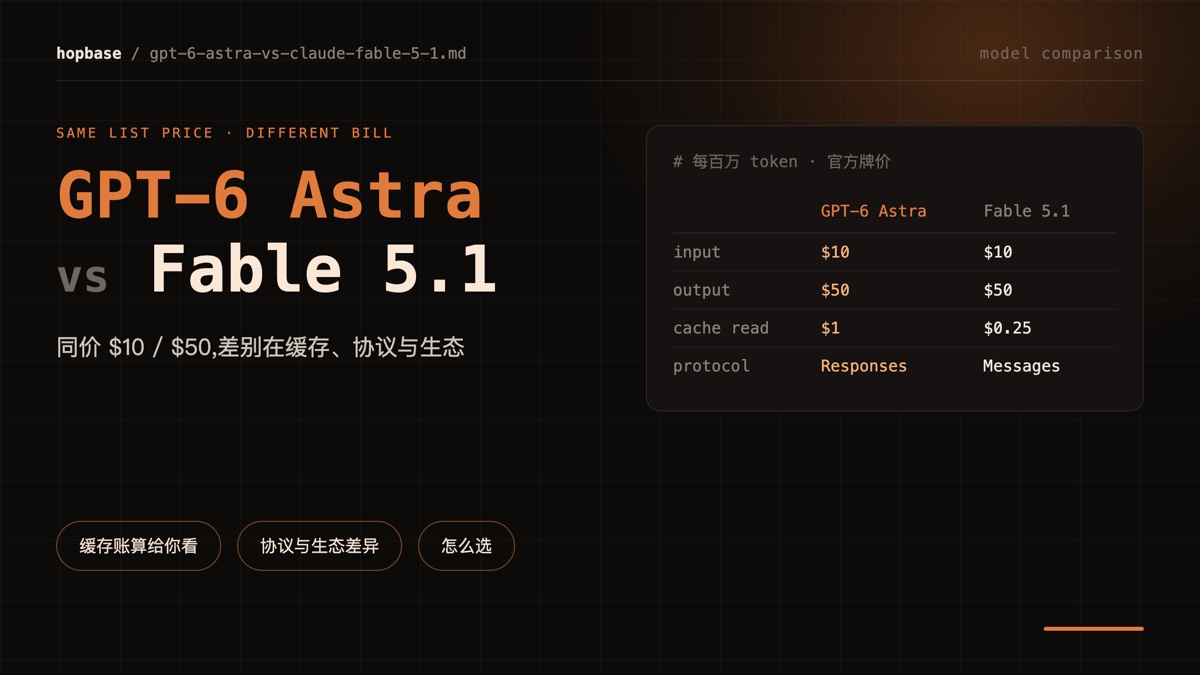
The short answer: GPT-6 Astra and Claude Fable 5.1 list at exactly the same input and output price — $10 and $50 per million tokens. So "which is more expensive" is the wrong question. Three things actually decide your bill. First, the cache pricing model: Fable 5.1 charges $0.25 for a cache hit (2.5% of input price) against GPT-6 Astra's $1 (10%), but Anthropic bills cache writes separately while OpenAI has not published a cache write price for GPT-6 — the break-even lands at roughly seventeen reuses of the same prefix, and the arithmetic is below. Second, protocol and ecosystem: Fable speaks Anthropic Messages and is native to Claude Code, GPT-6 speaks OpenAI Responses and Chat Completions and is native to Codex CLI, and for an existing codebase the migration cost usually exceeds the capability gap. Third, spec transparency and availability: Fable 5.1 has a published 1M context window and 128K max output and is fully rolled out, while OpenAI has not published a context window for GPT-6 Astra and is still releasing it in phases.
List price: input and output are identical
| Per 1M tokens | GPT-6 Astra | Claude Fable 5.1 |
|---|---|---|
| Input | $10 | $10 |
| Output | $50 | $50 |
| Cache read | $1 (10% of input) | $0.25 (2.5% of input) |
| Cache write | Not published | $12.50 (5 min) / $20 (1 hour) |
Both are served at vendor list price; full pricing is on the pricing page. Look at the last two rows: those are two genuinely different philosophies of cache billing, and they are the only source of difference in your bill.
The cache math: a break-even you can compute yourself
Anthropic's model is "expensive write, very cheap read." OpenAI's is "moderate read, write price unpublished." Comparing only what has been published, let N be the number of times the same prefix is reused:
- Fable 5.1 (5-minute cache): one write at $12.50/M + N reads at $0.25/M
- GPT-6 Astra: N reads at $1/M
Setting them equal gives N = 12.50 ÷ (1.00 − 0.25) ≈ 16.7. In other words:
- Reuse the same prefix more than about seventeen times and Fable 5.1's cache bill is cheaper. With the one-hour cache tier ($20/M) the threshold rises to about twenty-seven.
- Below that threshold GPT-6 Astra is cheaper — the write fee has not been amortised yet.
Concretely: a 15,000-token prefix of system prompt plus tool definitions, reused twenty times in one session. Fable 5.1 costs $0.1875 to write plus $0.075 to read, or $0.2625. GPT-6 Astra costs $0.300 in reads, and its write price is still unpublished, so the real figure may be higher. The gap is small, but the direction is clear: the longer the prefix and the more it is reused, the more Anthropic's cache model wins.
One caveat worth stating plainly: this is arithmetic on published prices, not a substitute for your own bill. Real hit rates depend on prefix stability, TTL and concurrent routing, and estimates routinely miss. HopBase's usage records break out input, cached-hit and output cost per request, so a week of real traffic beats any formula. For raising hit rates in the first place, see the prompt cache cost guide.
Protocol and ecosystem: usually the bigger cost
| GPT-6 Astra | Claude Fable 5.1 | |
|---|---|---|
| Protocol | OpenAI Responses / Chat Completions | Anthropic Messages (/v1/messages) |
| Native CLI | Codex CLI | Claude Code |
| SDK | OpenAI SDK, unchanged | Anthropic SDK, unchanged |
If your service is already built on one of these SDKs, moving to the other means reworking request construction, streaming event parsing, tool-call format and error handling. That work is usually worth more than the capability difference between the two models. Price the migration before you argue about the model.
Fable 5.1 also carries a few behavioural changes worth knowing when migrating from older Claude versions: forced tool calls are gone (any and tool values of tool_choice return 400), thinking blocks are bound to the model and must be replayed verbatim, and assistant prefill is unsupported. Details are in the Fable 5.1 launch post.
Spec transparency and availability
- Claude Fable 5.1: a published 1M context window and 128K max output, adaptive thinking always on (depth controlled via
output_config.effort), fully available across the Claude Max groups. - GPT-6 Astra: OpenAI has not published a context window or maximum output as of this writing, and we do not label specs the vendor has not confirmed. It is still rolling out in phases, currently available in the Codex Plus and Codex Pro groups, with
GET /v1/modelsas the source of truth.
For anything that has to go into a technical proposal with a concrete capacity commitment, that difference is real: one has an official number you can cite, the other currently only supports "whatever the API returns."
How to choose
- If you are already inside one ecosystem, stay put. Migration cost usually exceeds the capability gap, unless you have a specific, reproducible failure to point at.
- For prefix-heavy agent workloads, lean Fable 5.1. Past roughly seventeen reuses the cache bill starts winning clearly, and these workloads are the ones that lean on caching anyway.
- For a native Codex CLI experience, or a toolchain already built on the OpenAI protocol, take GPT-6 Astra. At identical list price, the engineering hours you do not spend are real money.
Both models are served at list price on HopBase and callable from a single key, which makes an A/B on real traffic straightforward. The split-test method is the three-step checklist in our GPT-6 versus GPT-5.6 comparison.
FAQ
Which is more expensive, GPT-6 Astra or Claude Fable 5.1?
Their input and output list prices are identical at $10 and $50 per million tokens. The difference is entirely in caching: Fable 5.1 charges $0.25 per cache hit and $12.50 (5 min) or $20 (1 hour) per write; GPT-6 Astra charges $1 per hit and has not published a write price. Which total is lower depends on how often you reuse a prefix.
How do I compute the cache break-even?
With N reuses of a prefix, Fable 5.1 costs 12.50 + 0.25N per million tokens on the five-minute tier, and GPT-6 Astra costs 1.00N. They are equal at N ≈ 16.7, so beyond about seventeen reuses Fable is cheaper. On the one-hour cache tier the threshold is about twenty-seven.
Can I call both models with the same key?
Yes. Both are served at list price on HopBase and callable with one enterprise key subject to group permissions, which makes splitting real traffic for an A/B straightforward. Note the protocols differ: Fable uses /v1/messages, GPT-6 uses /v1/responses or /v1/chat/completions.
What is GPT-6 Astra's context window?
OpenAI has not published an official figure as of this writing, and we do not label specs a vendor has not confirmed. Treat the metadata from GET /v1/models and your actual results as authoritative. Claude Fable 5.1 does have a published 1M context window and 128K maximum output.
How do I confirm I am reaching these models and not a substitute?
Check the model field echoed in the response body and run a fixed probe set as a channel comparison. The full method is in the API relay fidelity self-test.
For enterprise evaluation and cross-vendor selection testing, talk to an advisor; integration steps are in the documentation.